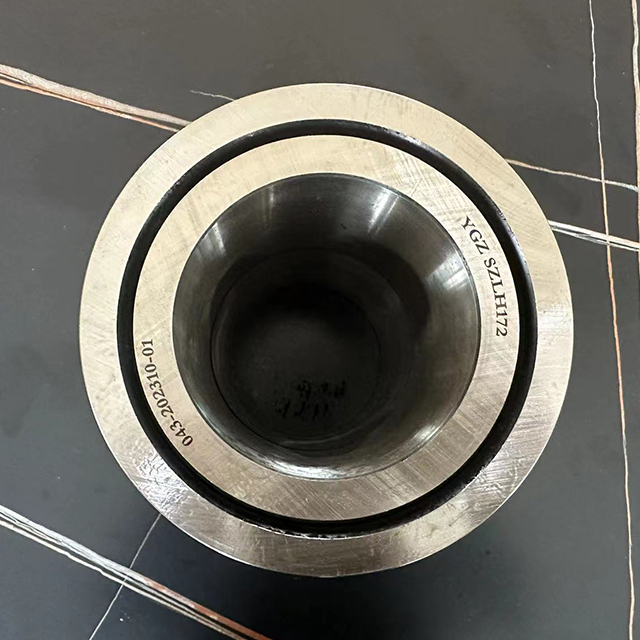
Selecting a tandem bearing for a 172mm mud motor (downhole motor / screw drilling tool) is not just a matter of matching a motor size. The right bearing must fit the bearing section precisely, carry high axial loads reliably, and remain stable under harsh downhole conditions such as vibration, shock loading, and drilling mud exposure.
This guide walks through a practical, engineering-friendly selection process—covering materials (e.g., 55SiMoVA), steel ball size (e.g., ϕ20.88\phi 20.88ϕ20.88 mm), ball count/configuration, load capacity inputs, and custom dimensions—so you can prepare an accurate RFQ and avoid costly fit or performance problems.
If you are sourcing for a 172mm motor now, you can reference our Tandem Bearing for 172mm Mud Motor and send your OD/ID and operating conditions for a recommendation and drawing support.
1) Start With the Basics (Before You Compare Specs)
Confirm the exact motor design—not only "172mm"
"172mm" indicates a motor size class, but bearing section designs can differ between series, generations, and OEMs. Two motors with the same nominal size may require different:
Best practice: prepare an assembly drawing, legacy part number, or at least measurements of the mating components before requesting a quote.
Define the operating conditions that drive bearing choice
Even with identical dimensions, the correct internal configuration depends on how the motor will be used. For a practical RFQ, try to provide:
Axial load level (or drilling parameters such as WOB range)
RPM range
Mud type and solids content assumptions
Temperature range
Target run hours/service interval
Shock/vibration severity (formation, drilling mode, start/stop frequency)
If you cannot disclose load data, share the drilling parameters you can disclose—an experienced manufacturer can often estimate what the bearing must withstand.
2) A Step-by-Step Selection Framework
A reliable tandem bearing selection process for a 172mm mud motor typically follows these steps:
Confirm fit: OD, ID, stack height, and any critical tolerances
Confirm axial load requirement: typical/max load and needed safety margin
Select material appropriate for strength and service environment
Choose rolling element design: ball size, ball count, and configuration
Align assumptions about lubrication/protection within the assembly (as applicable)
Define QC and documentation requirements
Finalize customization and complete drawing approval before production
This prevents the most common failure mode in sourcing: "It looks similar on paper, but doesn't fit or doesn't last."
3) Materials: What to Choose and Why
Why material matters in downhole service
Mud motor bearings operate under combined stress factors:
Material choice (together with heat treatment and process control) affects:
55SiMoVA (example used in 172mm tandem bearings)
One commonly used material for this type of tandem bearing is 55SiMoVA, often selected to support high strength and long service life designs when manufactured and processed correctly.
When requesting a quote, it's reasonable to ask for:
material certification/traceability
confirmation of the manufacturer's quality management system (many suppliers reference ISO-style systems such as ISO 9001)
any inspection documentation your project requires
When alternative materials may be considered
Some operating environments may push requirements beyond a standard specification—for example:
unusually high temperature service
more aggressive mud chemistry
customer-specific material standards
In those cases, the final material should be decided based on your design constraints and operating conditions.
4) Rolling Elements: Ball Size, Ball Count, and Configuration
Rolling elements are not a "minor detail." They strongly influence load sharing, contact stress, and stability.
Below is a real-world reference point for a 172mm mud motor tandem bearing:
Steel ball size: ϕ20.88\phi 20.88ϕ20.88 mm
Number of steel balls: 18
Columns (configuration option): 9–12 (depending on design)
Ball size (example: ϕ20.88\phi 20.88ϕ20.88 mm)—what it influences
At a high level, ball size affects:
how the bearing carries load (contact geometry and stress distribution)
how robust the bearing may be under heavy axial thrust
trade-offs between load capability and packaging constraints
You don't need to "pick" a ball diameter in isolation—but you do need to confirm that the chosen rolling element design matches your load and space requirements.
Ball count (example: 18)—why quantity matters
Ball count influences:
From a procurement perspective, ball quality consistency also matters. If your application is sensitive, you can request clarity on inspection practices for rolling elements (without needing to publish proprietary details on your website).
"Columns" (example: 9–12)—why configuration options exist
Some tandem bearing designs provide configuration choices such as 9–12 columns. While the exact definition depends on the bearing structure, configuration choices typically relate to:
If you're unsure which configuration you need, share your assembly constraints and operating conditions so the manufacturer can recommend the best option.
5) Dimensions and Fit: OD/ID, Stack Height, and Tolerances
Published reference ranges (172mm example)
For a 172mm mud motor tandem bearing, you may see ranges such as:
These are useful reference points—but do not assume the midpoint is "standard."
What "custom dimensions" usually means
When a supplier says "all sizes can be customized," customization usually includes some combination of:
OD and ID adjustments to match shaft/housing fits
overall height / stack height (critical for assembly preload/stack-up)
geometry alignment with mating components in the bearing section
specific tolerance requirements and inspection methods
How to avoid fit issues that waste time and money
To reduce risk:
Do not select only by "172mm motor size."
Provide a drawing or measurements of mating parts.
Clarify which dimensions are critical and whether you need:
a specific fit class on the shaft/housing
a maximum runout or geometry requirement
acceptance based on measurement method (how it will be checked)
In downhole motor assemblies, a small mismatch can lead to assembly problems, unstable operation, and shortened service life.
6) Load Capacity: How to Specify What You Need
Many buyers want a simple number, but in mud motor applications, load and life are a system outcome. You can still specify requirements effectively by providing the right inputs.
Where axial load comes from in mud motors
Primary axial load drivers include:
What to provide so the manufacturer can confirm capacity
For the most accurate recommendation, provide:
typical and maximum WOB (or axial thrust estimate)
RPM range
duty cycle (continuous vs intermittent)
target service interval (run hours)
any known history: prior bearing life, failure patterns, and what changed
Even if the supplier does not publish load ratings on the website, these inputs enable them to select or design an internal configuration that matches the requirement.
Why safety margin matters
Downhole conditions include uncertainty: formation changes, shock events, and variations in drilling parameters. A reasonable safety margin helps protect reliability when conditions are not perfectly steady.
7) Quality and Certification: What to Ask for in an RFQ
For B2B buyers, quality is not a slogan—it's a checklist. Here are practical items to confirm.
Quality system (example: ISO 9001 approach)
If your supplier indicates they follow a certification/quality system (often including ISO 9001), clarify what documentation can be supplied with your order (COC, inspection reports, traceability).
Suggested inspection items (useful and realistic)
Depending on your project requirements, you can request:
material traceability documentation
dimensional inspection (OD/ID/height and any critical dimensions)
appearance and surface condition checks
verification tied to processing steps (where applicable)
packaging and corrosion protection for shipping/storage
This helps align expectations before production begins.
8) Copy/Paste RFQ Template (172mm Mud Motor Tandem Bearing)
You can copy the template below into your email or inquiry form to speed up the process:
RFQ: Tandem Bearing for 172mm Mud Motor
Motor size/series: 172mm (please specify series if available)
Application: mud motor / downhole motor / screw drilling tool
Required dimensions:
Rolling element preference (if known):
Material requirement: ___ (reference example 55SiMoVA)
Operating conditions:
QC/documentation: ___
Quantity: ___
Delivery terms & destination: ___
Send this RFQ with your drawing/measurements, and we can recommend a suitable tandem bearing configuration and confirm customization feasibility.
9) Common Selection Mistakes (and How to Prevent Them)
Mistake 1: Choosing by motor size only
Fix: confirm OD/ID/height and mating part details. "172mm" is not enough.
Mistake 2: Ignoring stack height and tolerances
Fix: define critical dimensions and how they will be inspected.
Mistake 3: Underestimating shock and dynamic loads
Fix: provide typical and maximum drilling parameters, plus any known shock/vibration conditions.
Mistake 4: Not considering paired components in the bearing section
Fix: review the full bearing section design. In many assemblies, thrust and radial support work together (for example, tandem bearing + radial bearing arrangements).
Mistake 5: Skipping drawing approval for "custom" parts
Fix: request and approve drawings/spec sheets before production to prevent mismatch.
Conclusion: The Right Tandem Bearing Choice Is Fit + Load + Process Control
To choose a tandem bearing for a 172mm mud motor, focus on four pillars:
Correct fit (OD/ID/stack height + tolerance requirements)
Axial load capability aligned with real operating conditions
Material and manufacturing consistency (e.g., 55SiMoVA with traceability and QC)
Appropriate rolling element design (ball size ϕ20.88\phi 20.88ϕ20.88 mm and configuration such as 18 balls / 9–12 columns as reference options)
If you share your motor size, required dimensions, and operating conditions, a qualified manufacturer can recommend the right tandem bearing configuration and support customization efficiently.